
Our main focus
Promotion and protection of human rights including sensitization, community training on human rights and advocacy of Key population rights.
Key populations in Uganda continue to face violence, discrimination, and other forms of human rights violations which is a big hindrance to our work thus human rights advocacy is at the highest note of our work.

There is need for systems change for inclusion and full participation of male sex workers in areas including programs, regulations, and even funding allocations. Strategic Advocacy will advance broad scale change and impact approach to promote and defend male sex workers based on a clear understanding of our surrounding social, public health, political and policy context, building support to influence specific action to achieve our desired change of inclusion and participation of male sex workers.
During implementations, we shall also do engagements with District Health officers (DHO), District Education Officers (DHE), Residential District Commissioners (RDC), Parish Chiefs and Local council officers among others in an aim for attitude change for inclusion and participation of sex workers and key population in all government programs and increased demand and access to health care services.
We shall also use this chance to disseminate our newly created digital platform ‘bond app’ meet and dating app for all for key populations being a safe one stop center in the comfort of their homes hence booking their fantasies safely online
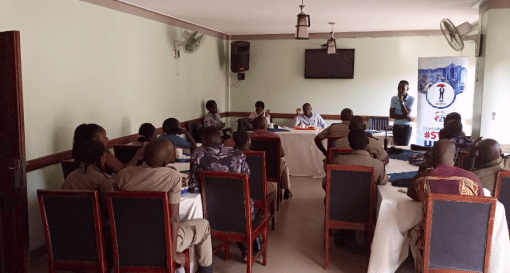
MONU Staff having dialogues with police officers
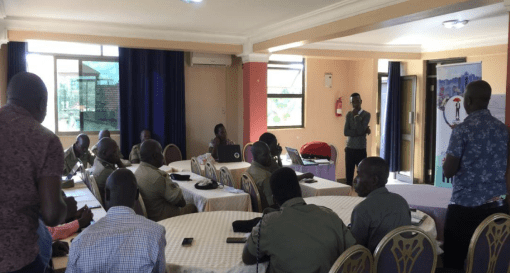
The programs Director Introducing MONU team and facilitators to the participants.
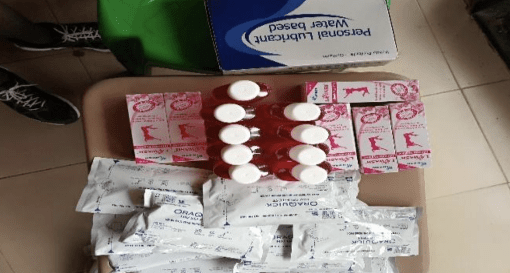
We offer HIV/AIDs prevention measures like Prep, Pep, Condom distribution and Lubricants, Referrals to health facilities, HIV Testing and Treatment, STI treatment and testing, Blood pressure readings, Hepatitis B testing and Treatment and all other related health care services

We might still be living in the Covid19 era, but if there’s anything the temporary post-covid era has made evident; it’s the increased use of the internet of things. From work spaces, to finding accommodation, to finding something to eat, or even getting groceries.
Bond is a platform that comes to extend that long list of things you can conveniently look out for and access, in the comfort of your living space, primarily as a meet and dating app; for all key population persons. Sex workers in Uganda have notably been victims of violence, with more than 80% of them experiencing recent client perpetrated violence and 18% experiencing intimate partner violence as Muldoon, KA (2015) reported in the BMC Public Health, on a systematic review of the clinical and social epidemiological research among sex workers in Uganda.

The pre-covid milieu had sex workers experiencing bits of police harassment in the wee hours of their working time, while awaiting clientele by the streets and other hotspots; wee hours that were also affected by the advent of the pandemic; hugely affecting business, the resultant being an effect on the wellbeing of these individuals. Criminalization of sex work, has from time to time bred social stigma in citizens, which in the long run is reflected in the huge numbers of sex workers who avoid health services and even when they access them; they’re often times not having sex-worker-friendly
The pre-covid milieu had sex workers experiencing bits of police harassment in the wee hours of their working time, while awaiting clientele by the streets and other hotspots; wee hours that were also affected by the advent of the pandemic; hugely affecting business, the resultant being an effect on the wellbeing of these individuals. Criminalization of sex work, has from time to time bred social stigma in citizens, which in the long run is reflected in the huge numbers of sex workers who avoid health services and even when they access them; they’re often times not having sex-worker-friendly services/personnel – which make sex workers conceal their occupations while attending to these clinics. Sex workers concealing their occupations while in health clinics is potential in living gaps in their management for them attaining a holistic wellbeing.
Furthermore; worth noting is are the rising levels of homophobic violence as well as HIVrelated social stigma, which are exacerbated by the conservative social attitudes and stigmatizing legislation; resulting into men who have sex with men seldom accessing HIV services.
This partially explains the UNAIDs’ estimation of 13% HIV prevalence among men who have sex with men and 37% HIV prevalence estimated to be among sex workers in general. A 2017 study found 40% of men who have sex with men experiencing homophobic abuse and 44.5% experiencing suicidal thoughts. On condom use, as a method of HIV and other STI prevention, a 2015 evidence review; still by Muldoon, KA (2015); found a section of Ugandan sex workers between 33% and 55%, being inconsistent with condom use; an initiative gaining confidence in the fact that clients often times pay more for sex without a condom!
With such issues at hand, the internet of things brings us a solution with the creation of the Bond app, for sex workers and other key populations – all over the nation to be able to conveniently perform – safely, conveniently and responsibly.
- Economic Empowerment
- Legal Support
- Health and legal sensitization


We mapped the four districts where we carry out our operations (Mukono, Wakiso, Mbale, and Kampala) and the incense of this mapping exercise was to know the number of hot spots within our areas of operation; those that have been added on since our last mapping which was done last year, find out the health service providers within in these areas that have been added on, to carry out a needs assessment for our members and also to introduce Men of the Night Uganda to new members as an organization to the community of male sex workers who didn’t know who we are.
The mapping excise was carried out by MONU staff as they understand the demographics of the male sex work community.
Due to COVID 19, we did not visit hot spots within all the four districts that host sex workers as they were still under lock down. Unlike the previous mapping where we interacted with hot spot managers, we only invited male sex workers for dialogues and also visited health centers and interacted with health workers who told us about their challenges and achievements in the area of serving key populations.
This a weekly program that is carried out on Mondays where our members meet to talk about their week’s work, the problems they encountered during the week and how their work can be improved. During these meetings, we also document the violations they encountered for example police brutality, client assaults and discrimination from service providers.
This is the only space where our members meet to discuss different issues that affect their personal lives and work. This is an hour of conversation about topics that male sex workers don’t often talk about or aren’t as honest as they would wish to be when they do. Male sex workers often times have disadvantage when if to “sex talk” and this disadvantage amplifies its self when they love and or have sex with clients. The main issue here is to talk about sex and sexual health rights in a not so stuffy environment.
In 2020, this program was carried out in all the five districts that we operate in.
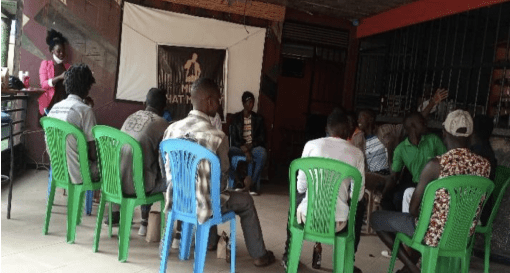
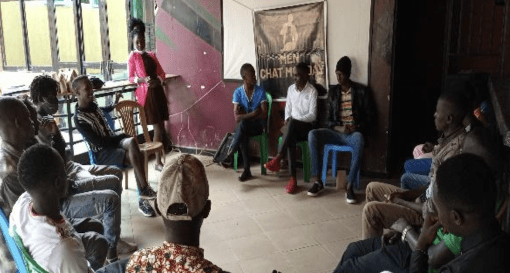
Session in progress conducted by a health worker
Health and rights advocacy for inclusion and service availability for Key populations has registered notable achievements with establishment of numerous Key Population Organizations that provide HIV services of test and refer to community members, gaps. remain in establishment of productive partnerships that allow for each organization to serve the target community without duplication of work for the same target audience thus leaving the movement growing but not strengthened.
Key populations are often difficult to reach for critical testing, care and treatment services especially those in rural areas as a result accessing safe, effective and quality Health care related services remains very low. This challenge is higher for male sex workers While stigma and fear of violence is high, there are other significant barriers such as police harassment, Advocacy/funding policies and insufficient community based capacity that continue to prevent male sex workers and Key populations from accessing the necessary health care services.
Through service extension directed to the target community with a rotational schedule, grass root to grass root mobilizing, effective messaging and mass media outreach we can support initiatives to disrupt these statistics for key populations.

Our members are equipped with skills and information to serving the community in terms of service delivery and its mostly done across in all our areas of operation and quarterly
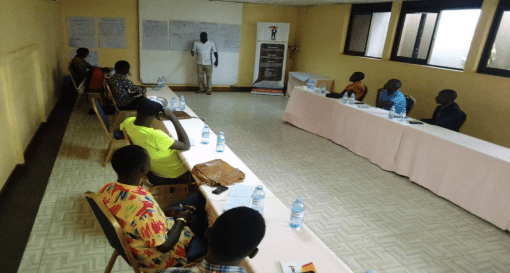
Trainer takin taking the group through the session in Mbale District
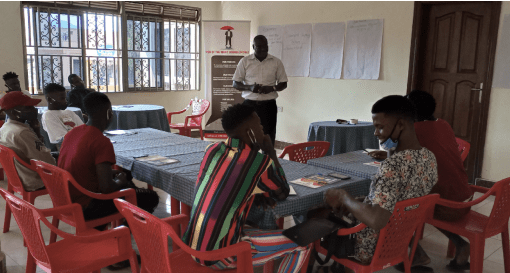
Facilitator taking participants through the session in Mukono District
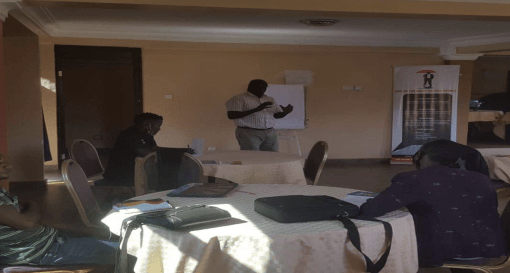
Facilitator taking the participants through the session in Kampala District
Health and rights advocacy for inclusion and service availability for Key populations has registered notable achievements with establishment of numerous Key Population Organizations that provide HIV services of test and refer to community members, gaps. remain in establishment of productive partnerships that allow for each organization to serve the target community without duplication of work for the same target audience thus leaving the movement growing but not strengthened. Key populations are often difficult to reach for critical testing, care and treatment services especially those in rural areas as a result accessing safe, effective and quality Health care related services remains very low.
This challenge is higher for male sex workers While stigma and fear of violence is high, there are other significant barriers such as police harassment, Advocacy/funding policies and insufficient community based capacity that continue to prevent male sex workers and Key populations from accessing the necessary health care services. Through service extension directed to the target community with a rotational schedule, grass root to grass root mobilizing, effective messaging and mass media outreach we can support initiatives to disrupt these statistics for key populations.
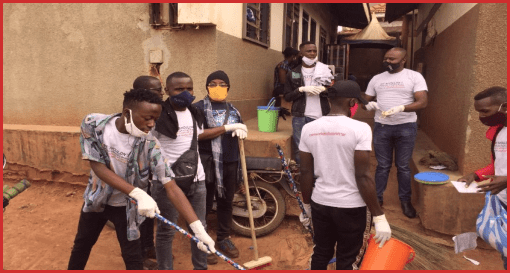
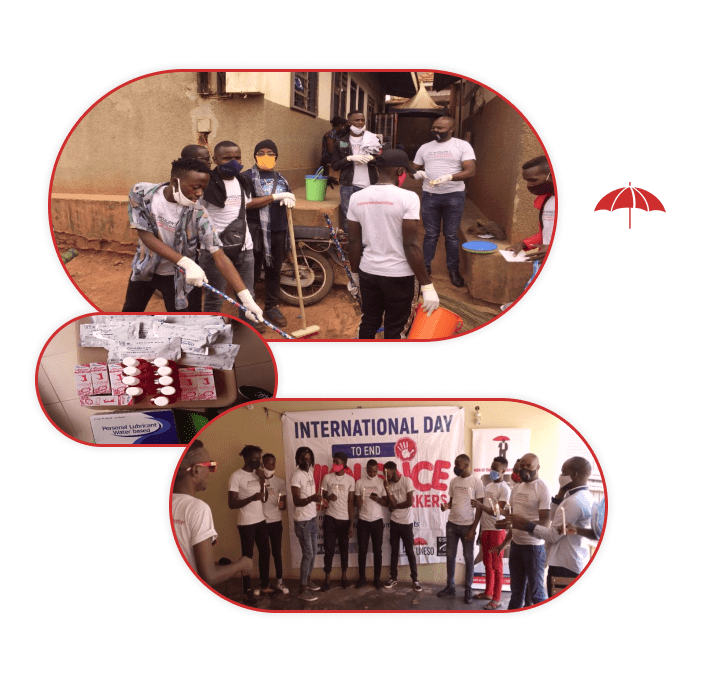
Members engage in cleaning one of the police stations in commemoration of international day to end violence against sex workers
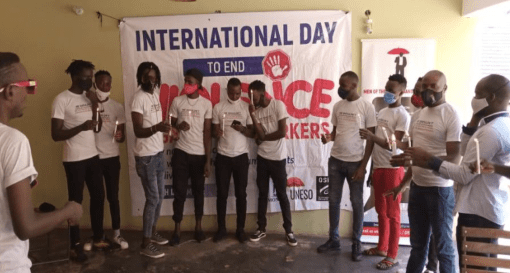
Members light candles in commemoration of our fallen comrades
1
To develop and advocate for a broad-based movement for key populations’ health and sexual rights in Uganda
2
To advocate for policy and law reforms that reduce the criminalization and stigmatization of key populations in Uganda
3
To increase knowledge, raise awareness and ensure realization of key populations health and human rights in Uganda
4
To build partnerships and empower key populations on issues of prevention, health interventions, policies and rights in Uganda
5
Support effective prevention, treatment, care and support for key populations with and affected by HIV/AIDS, TB and other related health issues in Uganda

Join us in our mission to promote and protection of human rights including sensitization, community training on human rights and advocacy of Key population rights.
 Men of the Night Uganda